
Pro Kabaddi Team Building Explained: How Franchises Build a Winning Squad
The Pro Kabaddi League is certainly one of the most talked about league in India, and intense competition is increasing after every passing years and the franchise is all set and ready for 13th edition. Whlile the…
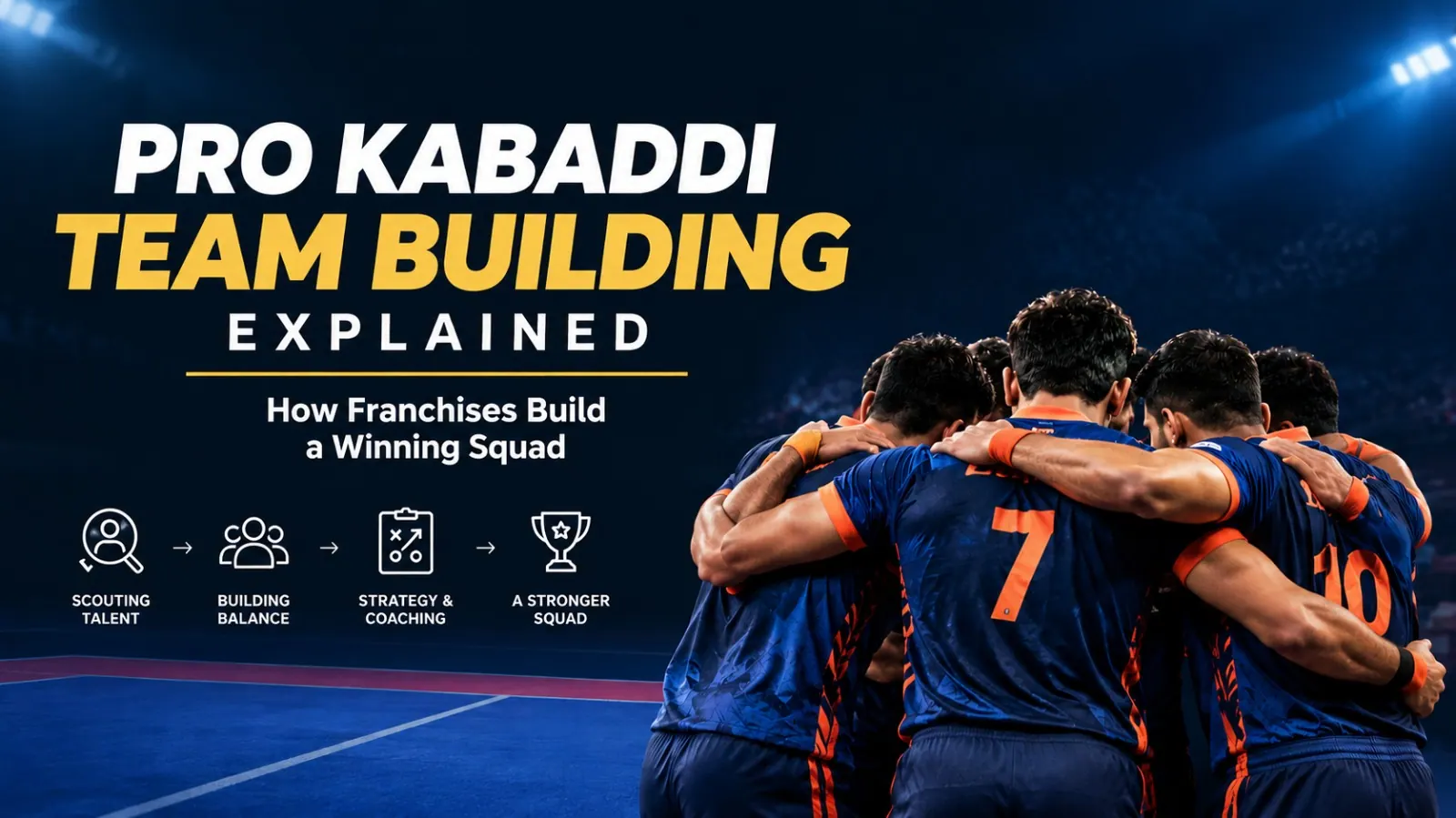
The Pro Kabaddi League is certainly one of the most talked about league in India, and intense competition is increasing after every passing years and the franchise is all set and ready for 13th edition.
Whlile the official confirmation dates related to Season 13, is yet to be declared.
Here in this article we will reveal how intense competition among franchise is developing and further dwell into How Pro Kabaddi Team Building happens and how they make sure to form a wonderful squad to be shared in the below format:
- The Purse Framework:
It is one of the most significant strategy used by stakeholders, where they are looking to build a formidable squad ahead of main event.
The Purse Framework comes in existence right from the moment it is anounced, where every franchise have to 18-25 players in their squad.
When it comes to match days, 14 players are roped in allowing them to play complete game for 40 minutes include one half time and 7 substitution per match is allowed.
Every franchise have purse value around 5 Crore, adjusted downward based on the cost of pre auction awareness strategy.
Each Squad also consist of 2 to 4 overseas players.
2. Players Categories and Base Prices:
When it comes to understanding annual player auction where talent is divided into four categories with predetermined – raiders, defenders and all rounders.
A- Category A- 30 Lakh
B- Category B- 20 Lakh
C- Category C- 13 Lakh
D- Category D- 9 Lakh
3. Retention and FBM Card:
As franchise you certanly want to go for picking new players instead we should also focus on bringning Retention card where they can use those power to retained some of the existing players inside franchise.
When it comes to Final Bid Match card, where every franchise could use these cards thriice during entire auction where they simply match price of the player they would like to pick once other franchise have picked for that substantial amount.
Using FBM card, any player could be retained for the minimum 2 years time period.
4. Balanced Mat Roles:
A winning squad is not only built based on picking one raider and forgeting the other aspect instead of relying on one star raider as tactician and stakeholders you need to decide how to form a squad keeping left and right corner, left and right cover, centre , left and right raider are part of it.
Also they must have backups around all these position.
That’s how you will be able to build a formidable squad.
5. Grassroot Academies and Feeder Systems:
All these franchise have their own local academy where they are constantly grooming athletes on regular basis.
With all these franchise local academies picking brilliant talent from there.
For someone like Yuva Paltan( Puneri Paltans) young squad they generally picked their players for Puneri side from domestic side.
Also scouts are build around these academies who constantly search for players who wants to make name for themselves.
Tournaments like Yuva Kabaddi Series, K7 Kabaddi League is prime example for it.
More Details Around Pro Kabaddi League Winning Mentality Explained:
The Pro Kabaddi League has completely reshaped the landscape of Indian sports, turning an ancient, mud-borne game into a sleek, high-intensity television spectacle. . Assembling a championship-caliber squad is far more complex than simply picking seven athletic players and sending them onto the mat. It requires deep financial foresight, keen tactical knowledge, precise timing during auction battles, and a sustainable feeder system that operates quietly throughout the entire calendar year.
The bedrock of every team-building effort revolves around the financial framework established by the league administration.
Every franchise operates under a strict purse ceiling, generally hovering around the five-crore limit, though this total is dynamically adjusted downward depending on pre-auction commitments and retention decisions.
Managing this purse requires a sophisticated balance between high-priced superstars and cost-effective role players.
Once the auction room opens, teams must navigate player categorizations across four distinct brackets ranging from marquee A-tier talent to entry-level D-tier prospects, each backed by mandatory base prices.
Spending too heavily on a single star raider can leave a team severely crippled in defensive positions, while playing it too conservative might mean missing out on game-changing match winners.
When match day arrives, a active match-day roster allows coaches to carry crucial bench depth, enabling continuous physical rotation and strategic substitutions across forty demanding minutes of play.
Furthermore, international quota mandates guarantee that foreign talent, particularly tactical defenders and raiders from traditional powerhouses like Iran, brings unique defensive mechanics and varied raiding styles to the mat.
Beyond raw bidding, squad stability relies heavily on pre-auction retention mechanics and strategic utilization of the Final Bid Match capability.
Retention policies allow franchises to hold onto their established core and young developmental players before the rest of the pool goes under the hammer.
However, when top talent enters the open market, the Final Bid Match mechanism offers a crucial safety net.
It allows a franchise to match the highest closing bid made by a rival team, retaining their key contributor while ensuring the player receives full market value.
This mechanism prevents rich franchises from monopolizing top talent, maintains competitive parity across the entire twelve-team league, and gives management teams a second chance to execute long-term roster planning.
On the mat itself, building a balanced squad demands complete positional synergy rather than an over-reliance on individual brilliance.
Kabaddi is a game of fine margins where a single weak link in defense or an uncoordinated tackle can turn the momentum of a entire match.
Managers must carefully build around complementary skill sets, securing natural left and right corners who excel at ankle holds and chain coordination, alongside heavy-hitting left and right covers capable of executing mid-mat blocks and dashes.
On offense, relying exclusively on one main raider is a recipe for failure; successful squads combine right-sided and left-sided raiders, quick-touch specialists, and physical power-raiders who can score in do-or-die situations.
Having capable bench players who can seamlessly step into these specific tactical roles without a drop in performance is what separates playoff contenders from bottom-table squads over a grueling multi-month season.
Finally, the modern era of the Pro Kabaddi League has proven that long-term success cannot be bought exclusively at the auction table.
Franchises have increasingly shifted their focus toward building robust grassroot academies and comprehensive feeder networks.
Emerging platforms such as domestic youth leagues serve as vital hunting grounds where scouts identify future stars long before they catch the eye of the general public.
Integrating these homegrown young players into the main roster provides franchises with hungry, highly disciplined talent on manageable contracts, completing the circle of sustainable team construction in modern kabaddi.
| Section | Key Area | Details |
|---|---|---|
| Purse Framework | Squad size | Each franchise must have 18–25 players in its squad. |
| Purse Framework | Match-day squad | Teams select 14 players for a match, with seven substitutions allowed across the 40-minute contest. |
| Purse Framework | Salary purse | Each franchise generally operates with a purse of around ₹5 crore, adjusted downward based on pre-auction retention commitments. |
| Purse Framework | Overseas quota | Every squad must include 2–4 overseas players. |
| Player Categories | Category A | Base price: ₹30 lakh; usually elite or marquee players. |
| Player Categories | Category B | Base price: ₹20 lakh; established performers. |
| Player Categories | Category C | Base price: ₹13 lakh; emerging or mid-tier players. |
| Player Categories | Category D | Base price: ₹9 lakh; entry-level or lesser-exposed players. |
| Player Categories | Skill groups | Players are divided into raiders, defenders, and all-rounders across domestic and overseas pools. |
| Retention and FBM | Retention system | Franchises can retain key players before the auction to maintain squad continuity. |
| Retention and FBM | FBM purpose | The Final Bid Match card allows a franchise to buy back a released player by matching the highest final bid made by another team. |
| Retention and FBM | FBM usage | The number of FBM cards available depends on the number of Elite Retained Players retained by the franchise. |
| Retention and FBM | FBM tenure | An FBM player can be retained for either one or two seasons. |
| Balanced Mat Roles | Defensive structure | Teams need specialist left and right corners for ankle holds and chain tackles, plus left and right covers for blocks, dashes, and mid-mat defence. |
| Balanced Mat Roles | Raiding structure | Squads require a mix of right- and left-sided raiders, quick-touch raiders, and power raiders for do-or-die situations. |
| Balanced Mat Roles | Bench depth | Backup players must be able to replace starters without a major tactical drop over a long season. |
| Balanced Mat Roles | Strategic principle | A winning squad cannot rely on one star raider; positional balance and complementary skills are essential. |
| Grassroots and Feeders | Academy role | Franchises invest in local academies to develop young kabaddi players and build a long-term talent pipeline. |
| Grassroots and Feeders | Scouting network | Scouts track domestic tournaments and youth competitions to identify future stars early. |
| Grassroots and Feeders | Talent platforms | Events such as the Yuva Kabaddi Series and K7 Kabaddi League act as key scouting grounds. |
| Grassroots and Feeders | Franchise example | Puneri Paltan’s young-player approach, linked with Yuva Paltan, shows the value of developing domestic talent for the main squad. |
| Winning Mentality | League impact | PKL has transformed kabaddi from a traditional sport into a high-intensity, televised professional league. |
| Winning Mentality | Team-building challenge | Successful franchises combine financial discipline, auction strategy, tactical planning, and long-term player development. |
| Winning Mentality | Auction risk | Overspending on one star can weaken defence, while being too cautious can mean missing match-winners. |
| Winning Mentality | Competitive balance | Retention rules and FBM help teams maintain continuity while preventing richer franchises from monopolising top talent. |
| Winning Mentality | Sustainable success | Long-term contenders increasingly rely on academies, scouting, and homegrown players rather than auction spending alone. |
Frequently Asked Questions about Pro Kabaddi Team Building Explained:
Q-1: Talk to us little bit basic metrics taken to building a winning squad for PKL Franchise?
Answer: The basic metrics taken to build a winning squad for PKL Franchise is shared in the below format:
A- Purse Category
B- Player Categorization
C- Retention
D- Balanced Mat role
E- Grassroot and Scouting
F- Winning Mentality
Combining all these factors a franchise can make a formidable squad whic h would posses winning mentality to become players.
Q-2: Why FBM and Retention Card plays an important role in making formidable squad for PKL?
Answer: It is an interesting concept in itself, considering every team have limited purse value around 5 crore, where they have to build strong squad compromising 18 to 25 players, where retention along final bid match card is used by existing player who will match the amount taken by new franchise and minimum period they would stay in one franchise is around 2 years where they can stay without any obstruction or issues.
Q-3: What are dynamics and tactiical changes adopted by coaches to form a great squad?
Answer: Before dwelling into the concept of formidable squad, we would be looking to understand why some squad looks great on paper whereas some wouldn’t the best way to respond to these answers would be balance.
Without balance in all positions- left and right cover( with backups), left and right corner(with backups) , centre, right and left( raider)( with backups) all should be picked with backups so that all bases are covered effectively and efficiently and balance is keenly the most important that you need to keep in mind.
Formidable squad is also that squad who doesn’t look good on paper but also have that ability who can do well- in exact situations when it is offered in front of them.
My Perspective:
Pro Kabaddi League should work on all the shortcomings where they can rewrite all strategy and work on marketing tactics, where they could build a league which is extremely profitable and sustainable at the same time.
You certainly need sponsors to work on your fore where they could come in huge numbers and support their favorite teams.
It is all possible down to how great you are when it comes to picking winning momentum, and the moment they started wining everything else takes back seat.
PKL can leverage real-time bio-metrics and match tracking (e.g., raider heart rates, speed sensors, tackle impact forces) to offer sponsors high-visibility contextual placements during live broadcasts.
Introducing in-stadium companion apps with real-time gamification, free-to-play fantasy modules, and interactive voting will capture younger demographics who expect multi-screen entertainment.
In modern sports business, on-court victory is only the catalyst—the real commercial value comes from how effectively a franchise monetizes that success while it happens.
Broadcasters and marketers need to package key match-ups around historical rivalries and player narratives, turning ordinary league fixtures into must-watch prime-time events.
By executing on these structural changes, the Pro Kabaddi League can evolve from a successful television product into a resilient, highly profitable, and commercially sustainable sports ecosystem.
Teams are very much aware about all types of possible combinations they want to go for in times to come, all they need strong back ups who can fill those slot in case main players fail to fire as in Sports everything can happen, so you must have all sorts of plans to tackle them, also your ideas should reflect in your team combination on what should be their strategy moving forward in case plan A and B when they didn’t work out.