
Commonwealth Kabaddi Championship 2026: Full Journey, Results and Why India Remains the Best
Indian kabaddi has once again shown why it remains at the top of the international game. Both the Indian men’s and women’s teams won gold medals at the inaugural Commonwealth Kabaddi Championship 2026 in Ahmedabad, and…
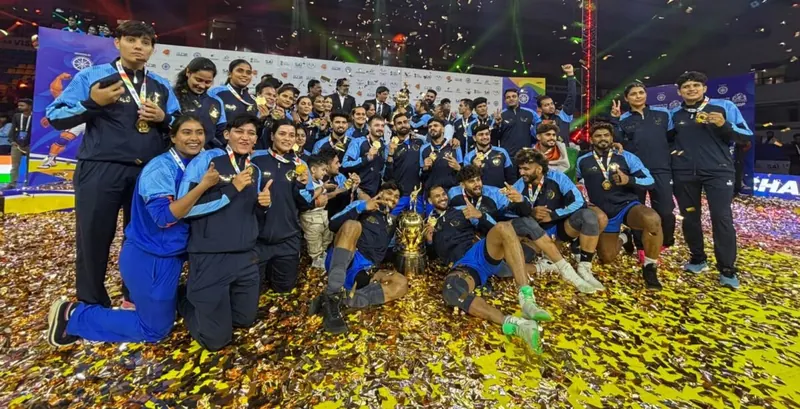
Indian kabaddi has once again shown why it remains at the top of the international game. Both the Indian men’s and women’s teams won gold medals at the inaugural Commonwealth Kabaddi Championship 2026 in Ahmedabad, and neither side lost a single match throughout the competition. While the men’s team defeated Sri Lanka 54-20 in the final, the women’s team comfortably beat Uganda 35-15 to complete a memorable double for the hosts.
The championship took place from October 23 to 31 at the Veer Savarkar Sports Complex in Ahmedabad, Gujarat. A total of 13 men’s teams and 10 women’s teams participated in the competition, with India competing against several Commonwealth nations. However, as the tournament progressed, the difference between India and the other participating teams became increasingly clear. Both Indian sides dominated the group stages, won their respective semi-finals and finished the competition with gold medals.
What made India’s performance even more impressive was the manner in which both teams won their matches. The men’s team collected six wins in the group stage before defeating Bangladesh in the semi-final and Sri Lanka in the final. Meanwhile, the women’s team won all four group matches before beating Sri Lanka and Uganda in the knockout rounds. There was hardly any point in the tournament when either Indian side looked in danger of losing control of a match.
India’s double gold also brought another discussion into focus: why is it so difficult for other countries to match India’s level in international kabaddi? The Commonwealth Championship provided another clear example of India’s strength, but the reasons behind this dominance go much deeper than one tournament. From grassroots kabaddi and the domestic competition structure to the Pro Kabaddi League, India’s player pool and match experience give the country a major advantage over most international opponents.
India Win Both Men’s and Women’s Gold Medals at Commonwealth Kabaddi Championship 2026
India entered the Commonwealth Kabaddi Championship as one of the strongest sides in both categories. However, the Indian teams did not rely only on their reputation. They backed it up with their performances on the mat and remained unbeaten from their opening matches until the gold medal games.
The men’s team, led by Surjeet Singh, finished at the top of Group A with six wins from six matches. They collected 12 points and recorded an impressive score difference of +124 during the group stage. Similarly, the women’s team, under captain Nidhi Sharma, finished first in Group A with four wins from four matches and a score difference of +127.
The final two matches also showed the difference in quality between India and its opponents. India’s men defeated Sri Lanka by 34 points, while the women’s team beat Uganda by 20 points. Therefore, both teams ended their campaigns without suffering a single defeat and became the first men’s and women’s champions of the Commonwealth Kabaddi Championship.
INDIA’S COMMONWEALTH KABADDI CHAMPIONSHIP 2026 CAMPAIGN
| Category | Men’s team | Women’s team |
| Group-stage matches | 6 | 4 |
| Group-stage wins | 6 | 4 |
| Group-stage defeats | 0 | 0 |
| Semi-final result | 56-27 | 39-14 |
| Final result | 54-20 | 35-15 |
| Total matches | 8 | 6 |
| Total wins | 8 | 6 |
| Gold medals | 1 | 1 |
Both teams remained unbeaten throughout the championship.
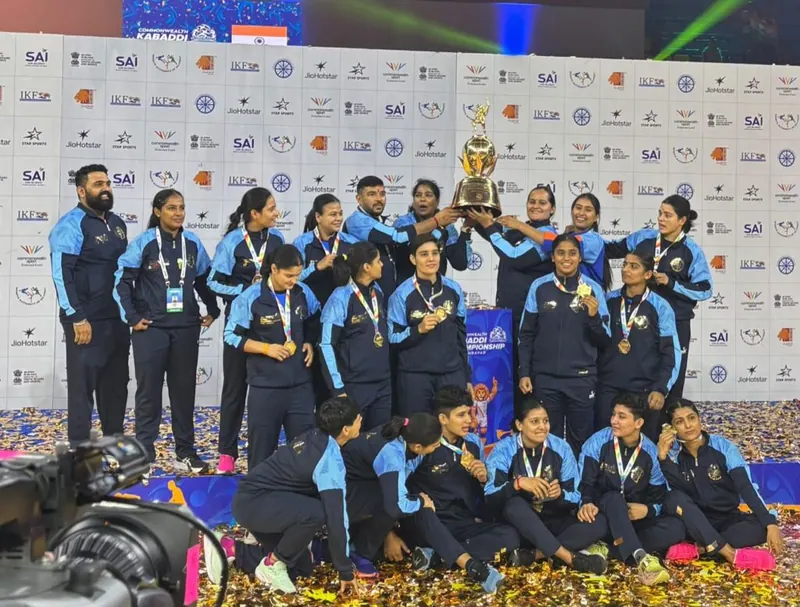
India’s Men’s Team Journey at Commonwealth Kabaddi Championship 2026
The Indian men’s team had a successful campaign from the very first match. Placed in Group A alongside England, Uganda, Malaysia, Nigeria, Tanzania and Sri Lanka, India had six group-stage matches to play. The team won every single one of them and finished at the top of the table without dropping a point.
The interesting part was that India did not depend on one or two players to win matches. The raiders and defenders contributed regularly, which made it difficult for opponents to find a way back into contests. Even when other teams tried to put pressure on India, the team’s raiding and defending combinations helped maintain control of the scoreboard.
Here is India’s complete men’s journey from the group stage to the final.
1. India vs England – India Win 46-26
India opened their Commonwealth Kabaddi Championship campaign against England on October 23. The English side managed to score 26 points, but India’s raiders and defenders controlled the match and secured a comfortable 46-26 victory.
It was a positive start for Surjeet Singh and his players. The 20-point winning margin gave the team an early boost and showed that India had arrived in Ahmedabad with a clear plan. England could not match India’s scoring throughout the contest, and the Indian team began its journey with two important points.
2. India vs Uganda – India Win 44-30
India faced Uganda in their second group-stage match on October 24. Uganda had shown some good performances in the competition, but facing India was a different challenge.
India won the contest 44-30, maintaining its winning run. Although Uganda managed to score 30 points, the Indian team stayed ahead and did not allow its opponent to take control of the match.
3. India vs Malaysia – India Win 37-23
The third match saw India take on Malaysia on October 25. By this stage, India had already picked up two victories, and the team continued its strong performance.
India defeated Malaysia 37-23 to register its third consecutive win. The winning margin was 14 points, and India once again showed that it could control a match through a combination of raiding and defending.
Malaysia failed to find enough answers against India’s overall game and could not stop the Indian side from maintaining its unbeaten record.
4. India vs Nigeria – India Win 50-23
India faced Nigeria in its fourth group match on October 26. The Indian team produced another strong performance, scoring 50 points and restricting Nigeria to just 23.
The 27-point winning margin was another example of the difference between the two teams. India’s raiders continued to collect points, while the defence made it difficult for Nigerian raiders to score regularly.
With this victory, India moved closer to securing the top position in Group A and qualifying for the semi-finals.
5. India vs Tanzania – India Win 48-20
The Indian men’s team continued its winning run against Tanzania on October 27. India scored 48 points and restricted Tanzania to 20, recording another convincing victory.
By this point, India had won five consecutive matches and had already secured qualification for the semi-finals. The team was also building a strong score difference, which reflected its control over the group-stage competition.
6. India vs Sri Lanka – India Win 45-24
India played its final group-stage match against Sri Lanka on October 29. Sri Lanka were among the stronger teams in Group A and had also secured their place in the knockout stage.
However, India was once again too strong for its opponent. The Indian men’s team defeated Sri Lanka 45-24 to complete a perfect group-stage campaign with six wins from six matches.
India finished Group A with 12 points and a score difference of +124. Sri Lanka finished second with five wins and one defeat. This was an important result because the two teams would meet again in the final on October 31.
7. India vs Bangladesh – India Win 56-27 in Semi-Final
After completing the group stage without a defeat, India faced Bangladesh in the semi-final on October 30.
Bangladesh had also enjoyed a good group-stage campaign, finishing second in Group B behind Kenya. However, the semi-final turned out to be a one-sided contest as India defeated Bangladesh 56-27.
India scored 56 points, while Bangladesh could manage only 27. The 29-point margin sent a clear message to the other teams that India was not ready to slow down in the knockout stage.
With this win, India entered the men’s final, where Sri Lanka awaited another meeting with the Indian side.
8. India vs Sri Lanka – India Win 54-20 in Final
India faced Sri Lanka for the second time in the tournament, this time with the gold medal on the line. The final took place on October 31, and the Indian team produced another outstanding performance to finish its campaign with a gold medal.
India defeated Sri Lanka 54-20, winning the final by 34 points. Aditya Shinde was India’s top scorer with 10 raid points, completing a Super 10 from 14 raids. Bharat Hooda added eight raid points, while Pankaj Mohite contributed six points and vice-captain Naveen Kumar scored five.
The defence was equally impressive. Yogesh Dahiya recorded a High 5, successfully completing all five of his tackle attempts. India scored 30 raid points and 14 tackle points, while also inflicting four All-Outs on Sri Lanka. Interestingly, the Indian team did not concede a single All-Out throughout the final.
India also made 24 successful raids from 40 attempts, while Sri Lanka managed only seven successful raids from 41 attempts. The difference in raiding success and defensive control explained why India won the final so comfortably.
Men’s Gold Medal
India – 54, Sri Lanka – 20
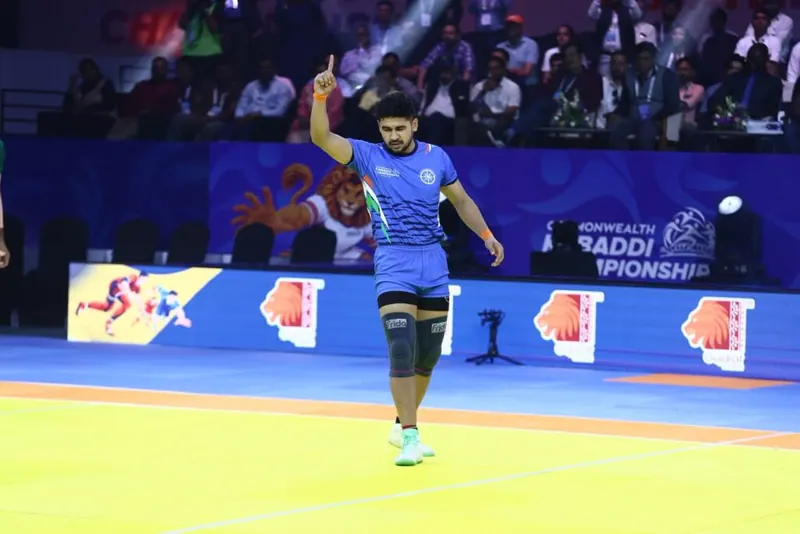
India’s Women’s Team Journey at Commonwealth Kabaddi Championship 2026
The Indian women’s team was just as dominant as the men’s side. Led by captain Nidhi Sharma, India started its campaign with a massive victory against Malaysia and continued to win matches throughout the group stage.
There were five teams in Women’s Group A: India, Malaysia, Singapore, Uganda and Nigeria. Each team played four group-stage matches, and the top two qualified for the semi-finals.
India finished at the top with four wins from four matches. The team scored 184 points and conceded only 57 in the group stage, finishing with a score difference of +127. It was an impressive performance from the Indian women, who controlled matches in both raiding and defending.
Here is a look at India’s complete journey.
1. India vs Malaysia – India Win 73-13
India began its women’s campaign on October 23 against Malaysia, and the opening match immediately showed the gap between the two sides.
India defeated Malaysia 73-13, recording a massive 60-point victory. The Indian team started aggressively and maintained control throughout the match. Malaysia struggled to deal with India’s raiding and defending combinations.
Sakshi scored 13 points, including eight raid points and five tackle points. Captain Nidhi Sharma also contributed eight raid points, while Renuka added nine raid points after coming off the bench.
India scored 40 raid points and 20 tackle points, while inflicting six All-Outs on Malaysia without conceding one. It was a remarkable opening performance from the defending champions of international women’s kabaddi.
2. India vs Singapore – India Win 32-16
India played Singapore in its second group-stage match on October 24. Unlike the opening match, the contest was relatively closer, but the Indian team still maintained a comfortable advantage.
India defeated Singapore 32-16 to collect its second consecutive victory. The 16-point difference showed that the Indian players were able to maintain control even when opponents managed to put up a better fight.
With this result, India continued its unbeaten run and moved closer to securing a place in the semi-finals.
3. India vs Uganda – India Win 41-18
India’s third group-stage match was against Uganda on October 25. Uganda was one of the better-performing teams in the women’s competition, but India produced another convincing performance.
India defeated Uganda 41-18, winning by 23 points. The Indian team looked comfortable throughout the contest and managed to maintain a clear gap on the scoreboard.
Interestingly, Uganda eventually reached the final after defeating Kenya in the semi-final. However, its first meeting with India had already shown how difficult it would be to match the Indian women’s team’s overall quality.
4. India vs Nigeria – India Win 38-10
India played Nigeria in its final group-stage match on October 26. The team had already secured qualification for the semi-finals, but that did not change its approach.
India registered a 38-10 victory, restricting Nigeria to just 10 points. The 28-point winning margin completed India’s perfect group-stage record.
The women’s team finished first in Group A with four wins from four matches and entered the knockout stage without losing a single game.
5. India vs Sri Lanka – India Win 39-14 in Semi-Final
India faced Sri Lanka in the semi-final on October 30. Sri Lanka had qualified from Group B after finishing behind Kenya, and the team was looking to secure a place in the final.
However, India once again controlled the match and defeated Sri Lanka 39-14. The Indian team won by 25 points and secured its place in the women’s gold medal match.
The result also showed that India was capable of maintaining the same level of performance during the knockout stage. After dominating the group stage, the team did not allow Sri Lanka to create any serious problems.
6. India vs Uganda – India Win 35-15 in Final
India faced Uganda for the second time in the competition, this time in the women’s final on October 31. Uganda had defeated Kenya 23-21 in the semi-final and earned its place in the gold medal match.
However, India proved too strong once again and defeated Uganda 35-15 to win the inaugural Commonwealth Kabaddi Championship women’s title.
Sakshi was India’s highest scorer with nine raid points from 10 raids. She scored seven points in the first half and was successful in all six of her opening-half raids. Anu contributed six raid points, while captain Nidhi Sharma added five points.
India’s defence also played an important role. Ritu Mitharwal and Suman Sahu recorded four tackle points each, while the team scored 20 raid points and 10 tackle points.
India inflicted two All-Outs on Uganda and did not allow the opposition to gain control of the final. Uganda’s Nakayongo Shirat scored 11 points, but the rest of the team struggled to produce enough points against India’s defence.
India finished the women’s competition with six wins from six matches, completing an unbeaten gold medal campaign. Sakshi also finished the championship with 52 points from six matches, becoming India’s leading scorer in the competition.
Women’s Gold Medal
India – 35, Uganda – 15
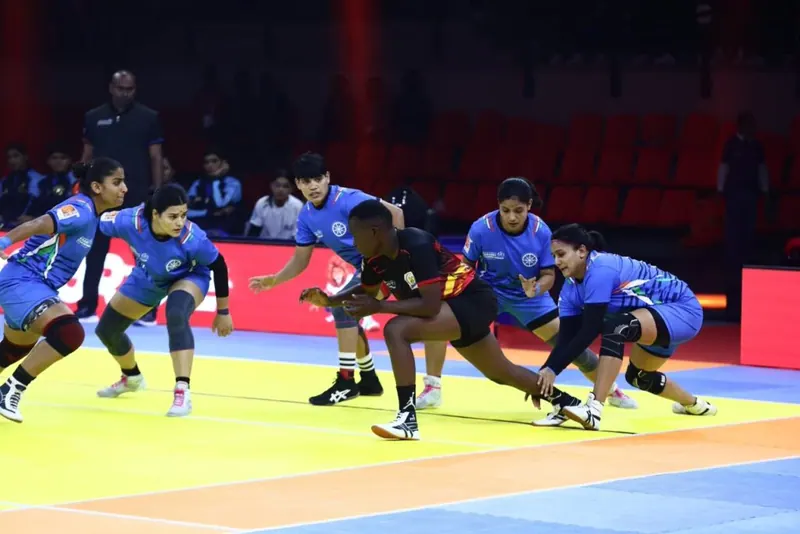
Why No Commonwealth Team Could Match India in Kabaddi
One of the biggest takeaways from the Commonwealth Kabaddi Championship 2026 was the difference between India and the other participating teams. Both Indian sides won all their matches, and their final victories came with comfortable margins.
The men’s team won its final by 34 points, while the women’s team won by 20 points. Even before the finals, India had produced several one-sided results in the group stage. These performances were not the result of one good day. They came from a well-developed kabaddi system that has produced skilled players across different age groups and parts of the country.
There are several reasons why India continues to hold such a strong position in international kabaddi.
1. Kabaddi Has a Strong Grassroots Base in India
The first and perhaps biggest reason behind India’s success is the popularity of kabaddi at the grassroots level. The sport is played in villages, small towns, schools, colleges, academies and local tournaments across different parts of the country.
Young players start playing kabaddi at an early age and get opportunities to compete in local competitions. As they improve, they can take part in district-level, state-level and national-level tournaments. This creates a large pool of players from which selectors and coaches can identify talent.
In many other countries, kabaddi is still developing and does not have the same number of players or the same level of regular competition. As a result, finding and developing experienced players can be more difficult. India, on the other hand, has a much bigger base from which it can select its national teams.
2. India’s Domestic Kabaddi Structure Gives Players Regular Competition
Another major advantage for India is the number of domestic competitions available to its players. State championships, national tournaments, university competitions, school-level events and professional leagues create regular opportunities for players to compete.
This is important because kabaddi is not a sport where players can improve only through practice sessions. Match experience is equally important. A raider needs to understand when to go for a bonus, when to attempt a touch point, when to return safely and when to take risks.
Similarly, defenders need to understand the right moment to attempt an ankle hold, block, dash or chain tackle. Indian players get opportunities to learn these situations through regular matches. Therefore, when they enter international competitions, they already have experience of playing against different styles and types of opponents.
3. Pro Kabaddi League Has Changed the Standard of the Sport
The Pro Kabaddi League has played an important role in improving the standard of kabaddi in India.
Since its introduction, the league has provided players with a professional competition where they compete against some of the best raiders and defenders in the country and from overseas. It has also helped players improve their fitness, technical skills, match planning and understanding of modern kabaddi.
Players are regularly exposed to different playing styles, strong defensive combinations and experienced raiders. This experience helps them make better decisions during international matches.
The Commonwealth Championship also included several Indian players with professional kabaddi experience. Men’s final performers such as Naveen Kumar, Pankaj Mohite, Bharat Hooda and Aditya Shinde have experience of competing at a high level, while India’s women’s squad included players such as Nidhi Sharma, Sakshi, Anu and Ritu Mitharwal.
When players spend years competing against strong opposition in domestic and professional tournaments, international matches become easier to manage. This is one of the biggest advantages India currently has over most other kabaddi-playing nations.
4. India Has Quality Raiders and Defenders in Both Categories
Kabaddi is a game where raiding and defending need to work together. A team cannot win regularly by depending only on its raiders or only on its defenders.
India has built a strong pool of players who can contribute in both departments. The men’s side had several raiding options in Aditya Shinde, Bharat Hooda, Pankaj Mohite and Naveen Kumar. At the same time, defenders such as Yogesh Dahiya, Surjeet Singh and Shubham Shinde gave the team a strong defensive unit.
The same was true for the women’s side. Sakshi, Anu and Nidhi Sharma contributed in attack, while Ritu Mitharwal and Suman Sahu played important roles in defence.
This balance is important because opponents cannot focus on stopping just one player. Even when one raider has a quiet match, other players can score points and help the team maintain its advantage.
5. India’s Defence Makes It Difficult for Opponents to Score
A strong raiding unit can win matches, but a strong defence can make those victories much easier. India has developed defenders who understand how to tackle different raiding styles and work together as a unit.
In kabaddi, defenders need to communicate and maintain the correct distance between one another. A poorly timed tackle can give the raider an easy point, but a coordinated defence can stop even an experienced raider.
India’s men’s final performance against Sri Lanka was a perfect example. Yogesh Dahiya scored five tackle points from five attempts, while the team recorded 14 tackle points overall. More importantly, Sri Lanka managed only seven successful raids from 41 attempts.
The women’s team also defended well against Uganda, restricting it to 15 points in the final. These numbers show that India’s advantage does not come only from scoring points. The team also knows how to stop opponents from building their own attacks.
6. Indian Players Have Experience of High-Pressure Matches
Another reason behind India’s success is the experience of playing important matches regularly. Players who compete in national championships and professional leagues understand how to handle situations where the score is close or where a team is facing a strong comeback.
This experience helps players remain calm and follow their plans instead of making unnecessary mistakes. It also helps coaches make changes according to the match situation.
The Commonwealth Championship was a good example of India’s ability to maintain its performance across a complete tournament. Both teams won their group-stage matches, handled the knockout rounds and performed strongly in the finals.
However, India’s success should not be explained only through match experience. It is the combination of technical knowledge, fitness, teamwork, player depth and regular competition that makes the country so difficult to beat.
7. India’s Women’s Kabaddi System Is Also Very Strong
India’s strength is not limited to men’s kabaddi. The women’s team has also established itself as one of the strongest sides in the world.
The Commonwealth Championship showed that the women’s team had the same advantages as the men’s side. India had multiple raiding options, a strong defence and players who understood how to work together.
The 73-13 victory over Malaysia and the 35-15 win over Uganda in the final are good examples of that advantage. More importantly, India did not lose a single match during the competition.
The presence of experienced women players and a regular domestic competition structure gives India an advantage that many other countries are still trying to build.

Is India Really Unbeatable in International Kabaddi?
The Commonwealth Kabaddi Championship 2026 clearly showed that India was far ahead of the other participating teams. However, it would not be accurate to say that no country in the world can ever give India a tough fight.
There is one major name that needs to be included in this discussion: Iran.
Iran has been India’s strongest recent rival in international kabaddi. The country has a well-developed men’s and women’s setup and has regularly competed with India in major international competitions.
In fact, the 2026 Asian Games provided two excellent examples of how closely Iran can compete with India. The Indian men’s team defeated Iran 40-34 in the final, while the women’s team beat Iran 37-34 to win gold. Both finals were much closer than India’s Commonwealth Championship gold medal matches.
India’s overall Asian Games record is another reason why it is considered the most successful kabaddi nation. After the 2026 Asian Games, India had won nine men’s kabaddi gold medals and four women’s gold medals, taking its combined tally to 13. Iran remains the most important rival in this history, having also won Asian Games gold medals in both categories.
It is also important to remember that the Commonwealth Championship was not a competition featuring every major kabaddi nation in the world. Iran, for example, was not part of the participating field. Therefore, the results should be understood in the context of the teams that actually took part.
Still, this does not take anything away from India’s achievement. Winning every match in both categories and finishing with two comfortable final victories is a remarkable performance. The Asian Games results also show that India can compete with and defeat the strongest international opposition.
The correct conclusion is that India remains the most successful and one of the most complete kabaddi nations in the world. While Iran can give India a genuine fight, the overall depth of India’s player pool, domestic competitions and professional experience gives it a major advantage over most other countries.
India Men’s and Women’s Teams Complete a Perfect Commonwealth Championship Campaign
The Commonwealth Kabaddi Championship 2026 ended with India winning both gold medals and finishing the competition without a single defeat. The men’s team defeated England, Uganda, Malaysia, Nigeria, Tanzania, Sri Lanka, Bangladesh and Sri Lanka again in the final. Meanwhile, the women’s team defeated Malaysia, Singapore, Uganda, Nigeria, Sri Lanka and Uganda again to become champions.
The results also highlighted the difference between India’s kabaddi system and the level of development in several other participating countries. India’s players have access to regular competitions, professional leagues, experienced coaches and a much larger player base. These advantages become visible when the teams face international opposition.
Both the men’s and women’s teams also showed that India has quality beyond individual stars. The raiders scored regularly, the defenders made important tackles and the entire playing unit worked together throughout the competition.
For India, the inaugural Commonwealth Kabaddi Championship ended with a perfect result: two teams, two gold medals and zero defeats. The 54-20 men’s final victory and 35-15 women’s final victory were the final examples of a campaign in which India remained ahead from the opening day to the last match.