
Kabaddi Tackles Explained: Ankle Hold, Thigh Hold, Block, Dash, Chain and More
Kabaddi is a sport in which a raider enters the opponent’s half to score points, while defenders try to stop the raider from returning safely. Although raiding often gets attention because of quick touches, kicks and…
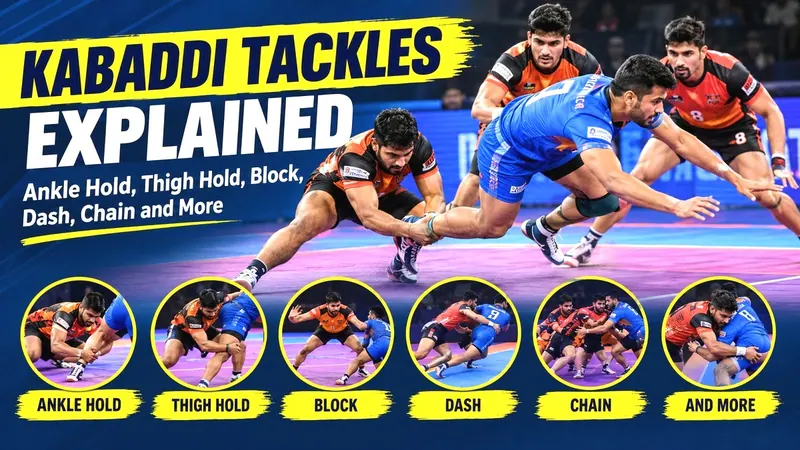
Kabaddi is a sport in which a raider enters the opponent’s half to score points, while defenders try to stop the raider from returning safely. Although raiding often gets attention because of quick touches, kicks and escapes, defending is equally important. A well-timed tackle can stop a strong raider and earn a point for the defending team.
However, tackling in kabaddi is not simply about using strength. Defenders must watch the raider’s movement, judge the right moment to act and work together to close the available escape routes. A defender may use an ankle hold, thigh hold, waist hold, block or dash, depending on the raider’s position and movement. Some tackles involve one defender, while others need two or more players working together.
The defensive positions also play an important role. Corners usually guard the outer areas of the defence, covers protect the central areas, and players between these positions help connect the defensive line. When these players move together, they can form a chain and make it difficult for a raider to escape.
In this guide, we explain the main kabaddi tackle techniques, the roles of corners and covers, and the defensive combinations used in the game. Each technique is explained in simple English, with examples of when defenders may use it during a raid.
What Is a Tackle in Kabaddi?
A tackle is a defensive action in which players try to stop a raider from returning to their own half. Defenders may hold the raider’s leg, control the upper body, block the route towards the midline or push the raider towards the boundary when the situation allows. The exact technique depends on how the raider moves and where the defenders are positioned.
In a standard successful tackle, the defending team earns one tackle point. The defenders must stop the raider from making a successful return, while the raider tries to reach the midline without being held. The challenge becomes greater when a raider touches a defender and quickly turns back towards their own half.
For example, imagine a raider entering the right side of the defending team’s half and attempting a toe touch near the corner. The right-corner defender may grab the raider’s ankle, while a nearby cover moves forward to help. If the raider cannot escape and return safely, the defence completes the tackle.
There is no single tackle that works in every situation. A low ankle hold may work against a raider who stretches a leg, while a block may be more suitable when the raider moves deep into the half and tries to rush back. Good defenders learn to read these situations instead of attempting the same move on every raid.
Types of Kabaddi Tackles
The main defensive techniques include ankle hold, thigh hold, knee hold, waist hold, block, dash and chain tackle. Each technique has a different purpose, and defenders often combine two or more moves to stop a raider.
1. Ankle Hold
The ankle hold is one of the best-known defensive techniques in kabaddi. In this move, a defender grabs the raider around the ankle to restrict leg movement and prevent an easy return towards the midline. Corner defenders often use this technique when the raider attacks from the side or stretches a leg to attempt a toe touch or bonus.
Timing is the main requirement for a successful ankle hold. The defender waits for the raider to bring a leg within reach and then tries to secure the ankle before the raider can pull away. If the grip is made at the wrong moment, the raider may change direction, drag the defender forward or escape before support arrives.
Example: A raider moves towards the left corner and stretches a leg to touch the defender. The left-corner defender catches the ankle as the raider tries to turn back. A nearby player joins the tackle, reducing the raider’s space to move.
A successful ankle hold also requires support from nearby defenders. The corner must control the leg without losing balance, while teammates close the escape route. If the raider is allowed to pull free and reach the midline, the first grip alone will not be enough to complete the tackle.
2. Diving Ankle Hold
A diving ankle hold is a variation of the regular ankle hold. Instead of waiting in a stationary position, the defender moves forward or dives towards the raider’s ankle when the opportunity appears. It is often attempted when a raider moves quickly into a corner or tries to escape after making a touch.
The move requires accurate timing because the defender commits their body towards a moving target. If the raider changes direction quickly, the defender can miss the ankle and leave a gap in the defensive line. Therefore, the defender should read the raider’s movement before making the attempt rather than diving without a clear chance.
For example, a raider may rush towards the boundary after touching the cover. The corner sees the raider’s leading leg move forward and attempts a diving ankle hold. The nearby cover then moves in to help control the raider’s body and prevent a return to the midline.
3. Thigh Hold
In a thigh hold, the defender targets the raider’s thigh and attempts to limit their movement. This technique can be useful when the raider moves across the court, turns their body or approaches a defender at an angle. Rather than controlling only the foot, the defender tries to restrict movement through a grip around the upper leg.
A thigh hold needs good timing, balance and a firm grip. The defender must judge the raider’s direction before making contact because a raider moving at speed can be difficult to control. Once the hold is established, a teammate may support the tackle by controlling the upper body or blocking the path towards the midline.
Example: A raider attempts to move from the centre towards the right side. The right-cover defender sees the raider change direction and grabs the thigh. The right corner then closes the space near the boundary, leaving the raider with fewer escape options.
Thigh holds are not limited to one defensive position. A corner or cover may attempt this move depending on the angle of the raid. The important part is to make the tackle at the right time and ensure that other defenders are ready to help if the raider continues moving.
4. Knee Hold
A knee hold involves catching the raider around the knee area to slow movement and limit the ability to turn or move forward. It is a low tackle that can be used when the defender gets a clear opportunity to control the raider’s leg. Like other leg holds, it depends on timing rather than strength alone.
The knee hold can become difficult if the raider is already moving at high speed or has enough room to change direction. Defenders must avoid reaching too early, as an unsuccessful attempt may allow the raider to pass the defensive line. Teammates should also be ready to close the escape route while the first defender attempts the hold.
In a match situation, a defender might try to control the knee when a raider moves past them with a long step. If the hold slows the raider, a nearby teammate can join the tackle. The move should be practised under proper coaching so players learn safe body positioning and avoid unnecessary pressure on the joint.
5. Waist Hold
The waist hold is a defensive move in which a player wraps their arms around the raider’s waist to control the upper body. It is useful when the raider comes close to the defender or tries to turn away after making a touch. By controlling the waist, the defender attempts to limit the raider’s ability to move freely towards the midline.
Unlike an ankle hold, which focuses on the lower leg, a waist hold targets the raider’s central body area. The defender needs a stable position and good balance to prevent the raider from turning out of the grip. A teammate can help by holding the legs or standing in the raider’s escape path.
Example: A raider makes a hand touch near the cover and turns quickly to escape. The cover catches the raider around the waist, while another defender moves in to support the tackle. Together, they try to prevent the raider from reaching the midline.
The defender should not depend on upper-body strength alone. If the grip is loose or the feet are poorly placed, the raider may break free. A good waist hold combines balance, timing and support from the rest of the defensive unit.
6. Block
A block is a defensive move in which a defender positions their body in the raider’s path to stop forward movement. Instead of immediately trying to catch a leg, the defender uses body position to close the route towards the midline. Blocks are often attempted when the raider enters deep into the half or tries to return quickly after getting a touch.
For a block to work, the defender needs to read the raider’s path and move into the correct position. If the defender arrives too early, the raider may change direction. If they arrive too late, the raider may pass them before the block is set.
Example: A raider reaches deep into the defending half and then rushes towards the midline. The cover steps across the path and closes the direct route. A corner moves in from the side, limiting the chance of the raider escaping around the defender.
A block is often stronger when another defender is ready to support it. The first player stops the raider’s forward movement, while teammates close any gaps. However, the defender must maintain control and avoid making an untimely move that allows the raider to slip past.
7. Dash
A dash is a tackle in which a defender uses quick movement and body force to drive the raider towards the boundary. It may be attempted when the raider is close to the sideline or is moving towards the outer part of the court. The aim is to prevent the raider from escaping and complete the tackle before they return to their own half.
Dash tackles require speed, strength, balance and good judgement. The defender must choose the moment carefully because an unsuccessful dash can carry them off balance or open a route for the raider. In addition, the defender must remain within the legal playing area to avoid being ruled out themselves.
Example: A raider attacks the right corner and tries to turn back along the sideline. The right-cover defender moves quickly across the raider’s path and attempts a dash. The corner provides support, making it harder for the raider to move around the defender.
A dash is not simply a blind push. It works best when the defender can predict the raider’s direction and use the boundary to reduce available space. If the raider is far away from the sideline, another technique may be more suitable.
8. Chain Tackle
A chain tackle is a defensive move in which two or more defenders coordinate their movements to stop the raider. Defenders may hold hands or keep their arms connected while moving into position, helping them close the space around the raider. It combines individual tackling skills with teamwork and communication.
The main purpose of chain defence is to reduce the raider’s escape routes. One defender may approach from the side while another guards the direct path towards the midline. When both players move together, the raider has less space to change direction or run through a gap.
Example: A raider moves towards the left corner and tries to return after a touch. The left corner and left cover close in together. One defender controls the raider’s movement, while the other blocks the path towards the midline.
A chain tackle can fail if the defenders move at different times or leave a gap between themselves. The raider may use that gap to escape or move between the defenders. For this reason, chain defence depends on trust, quick communication and an understanding of each teammate’s role.
9. Wrist Hold and Arm Hold
A wrist hold involves gripping the raider’s wrist to restrict arm movement, while an arm hold focuses on controlling the arm more broadly. These techniques may be used when the raider stretches an arm for a hand touch or tries to pull away from a defender. They can also provide support when another defender is already holding the raider’s leg or waist.
Wrist and arm holds need precise timing because raiders often extend their hands for only a brief moment. A defender who reacts too early may miss the grip, while a late attempt may allow the raider to turn away. These holds are often more useful as part of a combined tackle than as a move on their own.
For example, a raider reaches towards a defender for a hand touch. The defender catches the arm as another player moves towards the raider’s lower body. By controlling both movement and escape space, the defenders try to complete the tackle.
10. Back Hold
A back hold is used when a defender gets behind the raider and tries to control the upper body. It can happen when a raider turns away from a defender or tries to run towards the midline after a touch. The defender must move into the correct position and hold the raider long enough for teammates to provide support.
The challenge is to stop the raider from turning back into open space. If the defender reaches from the wrong angle, the raider may escape or pull the defender out of position. Therefore, back holds are generally more useful when the raider is already close to another defender and the team can complete the tackle together.
For example, a raider tries to escape between two defenders after making a touch. One defender controls the raider from behind, while another blocks the route towards the midline. The two players work together to reduce the chance of escape.
Kabaddi Defensive Positions Explained: Corners, Covers, Ins and Centre
A kabaddi defence is not a group of players standing randomly on the court. Each player has a position and a particular area to protect. These roles help defenders decide who should start a tackle, who should provide support and who should cover the raider’s escape route.
In the usual seven-player formation, the defence has two corners, two covers, two ins and one centre. The exact movement of these players changes during a raid, but the basic positions help the team maintain a balanced defensive line.
1. Corner Defenders
The right corner and left corner are positioned near the two sidelines. They often face raiders who attack from the outer areas of the court, and they frequently look for opportunities to use an ankle hold. Corners must judge the raider’s reach, footwork and direction before choosing the right moment to make a move.
Corners also need to understand when to wait rather than attack. If they move forward too early, they may leave a gap near the boundary that the raider can use to escape. A corner who waits for the right opportunity can force the raider to move towards the centre, where covers and other defenders can provide support.
Example: A raider moves towards the left side and attempts a toe touch. The left corner tries an ankle hold, while the left cover moves closer to support the tackle. Meanwhile, the other defenders adjust their positions to protect the remaining escape routes.
2. Cover Defenders
The right cover and left cover generally occupy areas closer to the centre than the corners. They help control the central routes and often support corners when a tackle begins near the sideline. Covers may use a block, thigh hold, waist hold or other body-control techniques depending on the raider’s movement.
Covers need to judge both the raider and their own teammates. If a corner attempts an ankle hold, the cover must decide whether to join the tackle or protect the space behind it. Moving without checking the corner’s position can create a gap that an alert raider may use to escape.
Example: The right corner catches the raider’s ankle, but the raider tries to drag the defender towards the middle. The right cover steps forward to help control the raider’s movement. Their combined effort may turn the initial ankle hold into a completed tackle.
3. Ins or In Defenders
The two ins are positioned between the corners and the covers in the usual defensive arrangement. They help connect these positions and can support a tackle when the raider moves across the court. Their role also involves keeping the defensive line balanced when one player moves forward.
Ins must avoid leaving large gaps while trying to help their teammates. If a corner and an in defender move too far towards one side, the raider may have space to attack another part of the defence. Good positioning allows the ins to provide support without weakening the rest of the formation.
For example, if the left corner is engaged with a raider near the boundary, the left in can move closer to help. At the same time, the cover maintains a position that blocks the route towards the centre. This creates a more complete defensive unit instead of leaving the corner to finish the tackle alone.
4. Centre Defender
The centre occupies the middle area of the defensive formation and helps maintain the team’s overall shape. This role is not always limited to a specialist defender, as the centre position may be occupied by a player who has just completed a raid or is playing within the team’s system. The central player must observe the raid and respond when teammates need support.
The centre also helps the defence avoid focusing too heavily on just one side. A raider may approach the corner to attract defenders before suddenly turning towards the middle. The centre needs to remain alert to such changes and help close the available space.
In a match, the centre might move forward when a raider enters deep into the defending half. However, if the raider changes direction towards a sideline, the centre must adjust rather than follow the original path. This helps the rest of the defenders retain their positions and respond together.
Kabaddi Defensive Combinations Explained
Individual tackle techniques are useful, but many successful tackles come from two or more defenders working together. These combinations allow one player to begin the tackle while another controls the escape route. The defenders must understand their roles and move at the right time.
1. Corner and Cover Combination
The corner-and-cover combination is one of the most common defensive partnerships in kabaddi. The corner often starts the tackle with an ankle hold or another low move, while the cover provides support by controlling the raider’s body or closing the central route. This combination can be useful when a raider attacks from the side and then tries to turn back towards the midline.
The corner must make the first move at the right moment. The cover should then read the situation and provide support without rushing into the same space as the corner. If both players coordinate well, the raider may find it difficult to change direction or break away from the tackle.
Match example: The left corner grabs the raider’s ankle during a toe-touch attempt. The left cover moves towards the raider’s upper body, while an in defender blocks the open route. The defenders use three different positions to complete one coordinated tackle.
2. Corner and In Combination
A corner and an in defender can also work together to stop a raider near the sideline. The corner may start with a low hold, while the in defender moves closer to prevent the raider from turning towards the centre. This combination is useful when the raider tries to enter a corner area and quickly change direction.
The in defender must maintain enough space to react to the raider’s next movement. If they move too close too soon, the raider may escape through the gap behind them. On the other hand, moving too slowly may leave the corner without the support needed to complete the tackle.
For example, the right corner attempts an ankle hold as the raider moves near the boundary. The right in closes the inside route, while the right cover remains ready to help if the raider moves towards the centre. Each player has a different job, but all three contribute to the same defensive action.
3. Ankle Hold and Thigh Hold Combination
This combination uses two different points of control on the raider’s body. One defender attempts to control a leg near the ankle, while another tries to restrict movement around the thigh. It can be effective when a raider is moving quickly and one hold alone does not provide enough control.
The key is coordination. If the ankle holder acts first, the second defender must judge whether the thigh hold is possible without leaving another route open. Both defenders should maintain balance and avoid pulling in opposite directions in a way that gives the raider room to escape.
Example: A raider attacks the left corner and tries to pull away after being caught by the ankle. The left cover approaches and attempts to control the upper leg. With one defender restricting the lower leg and the other limiting movement above it, the raider has fewer options to regain balance and reach the midline.
4. Block and Chain Defence
A block can stop the raider’s forward movement, but the raider may still try to move around the defender or change direction. A second defender can support the block by forming a chain or closing the nearby escape route. This allows the team to control both the raider’s movement and the space around them.
The first defender should concentrate on positioning their body across the raider’s path. The supporting defender must read the direction of movement and close the gap without leaving another route unprotected. When both players react together, the raider has less room to use speed or sudden changes of direction.
For example, a raider receives a touch deep inside the defending half and rushes towards the midline. The cover moves across the path to perform a block, while another defender approaches from the side. The second player limits the raider’s ability to move around the block, turning an individual action into a team tackle.
5. Dash and Cover Support
A dash is often attempted near a boundary, but it can be difficult to complete if the raider has enough space to change direction. A supporting defender can help close the inside route and make it harder for the raider to move away from the sideline. The combination therefore depends on positioning as much as physical strength.
The first defender needs to select the moment when the raider’s movement takes them close to the boundary. The supporting player should stay ready to close the remaining gap rather than follow the first defender blindly. This helps maintain a balanced defence if the raider changes direction at the last moment.
Example: The raider turns towards the right sideline after touching a defender. The right corner moves to restrict the raider’s path, while the right cover provides support from the inside. The defenders try to complete the tackle while maintaining their own position on the court.
6. Double Cover Tackle
A double-cover tackle involves two cover defenders responding together when the raider enters a central area. One player may attempt a block or waist hold, while the other closes the escape route or helps control the raider’s movement. This combination can be useful when a raider attacks the middle of the defence instead of the corners.
Both covers must watch the raider’s direction closely. If they approach from the same angle, the raider may turn around them and reach the midline. A better approach is to limit the available space while leaving one defender ready to respond if the raider changes direction.
For example, a raider enters through the centre and tries a quick hand touch before turning back. The first cover steps across the return route, while the second moves towards the side where the raider is attempting to escape. Their combined positioning reduces the raider’s room to move.
Quick Reference Table: Kabaddi Tackles and Defensive Roles
| Tackle or position | Main purpose | Common role in defence |
| Ankle hold | Restrict the raider’s leg movement | Corner |
| Diving ankle hold | Catch the ankle while moving towards the raider | Corner or nearby defender |
| Thigh hold | Restrict movement around the upper leg | Corner or cover |
| Knee hold | Control movement around the knee area | Any defender with a suitable angle |
| Waist hold | Control the raider’s upper body | Cover or supporting defender |
| Block | Close the raider’s path towards the midline | Often a cover |
| Dash | Drive the raider towards the boundary | Corner or cover |
| Chain tackle | Coordinate two or more defenders | Multiple positions |
| Wrist or arm hold | Restrict arm movement | Supporting defender |
| Back hold | Control the raider from behind | Supporting defender |
The positions listed here are common patterns, not fixed rules for every tackle. Defenders can use different moves based on the raider’s body position, the space available and the team’s plan. The central idea is to choose the right technique and ensure that teammates are ready to support it.
Common Mistakes Defenders Make in Kabaddi
Even a strong defender can fail to complete a tackle if their timing or positioning is poor. One common mistake is attacking too early. When a defender commits before the raider comes within reach, the raider can change direction and escape through the space left behind.
Another mistake is depending only on personal strength. An ankle hold, thigh hold or block requires the defender to judge the right moment and maintain balance. If the first defender cannot control the raider, nearby teammates must be ready to help instead of waiting for the tackle to finish on its own.
Poor communication can also weaken chain defence. If one defender moves forward while another remains too far away, the gap may allow the raider to escape. Teams should practise clear signals, suitable spacing and coordinated movement so that everyone knows when to begin and support a tackle.
Finally, defenders sometimes follow the raider too closely and forget to protect the rest of the court. A raider may use a sudden turn to move towards an unguarded route. Good defenders therefore balance pressure on the raider with awareness of their own position and the movement of their teammates.
How to Improve Kabaddi Tackling Skills
Improvement begins with learning the correct body position for each tackle. Players should practise ankle holds, thigh holds, blocks and other techniques under a qualified coach, starting with controlled drills before applying them in full-speed practice. Safe technique is especially important for moves involving the knee, ankle and upper body.
Footwork is another important part of defending. A defender needs to move sideways, forward and backwards without losing balance, while keeping enough distance to react to the raider. Regular movement drills can help players adjust their position without rushing into every attack.
Team practice should also include corner-cover combinations and chain tackles. Two defenders can practise closing space together, while three players can work on controlling the raider’s movement without leaving a clear route to the midline. Repeating these situations helps players understand when to begin a tackle, when to support a teammate and when to hold their position.
Watching match footage can help players identify common raider movements. A defender may notice that a particular raider often reaches with a hand before turning back, or prefers attacking one corner. Recognising such patterns can help the defence prepare, although players must still react to what happens during the actual raid.
Kabaddi defending combines timing, body control, quick movement and teamwork. Ankle holds and thigh holds help defenders control the legs, while waist holds and blocks limit the raider’s movement. Dashes can be useful near the boundary, and chain tackles allow multiple defenders to work together to close escape routes.
The corner, cover, in and centre positions help organise these defensive actions. Corners often begin tackles from the sides, covers support the central areas, and the remaining defenders help maintain the team’s formation. When defenders understand both their individual techniques and their teammates’ roles, they can respond more effectively to different types of raids.
Ultimately, successful kabaddi defence comes from choosing the right move at the right moment. Strength is useful, but awareness, balance, communication and coordinated movement are just as important in building a strong defensive unit.
Frequently Asked Questions About Kabaddi Tackles
Which are the main tackles in kabaddi?
The main kabaddi tackles include ankle hold, diving ankle hold, thigh hold, knee hold, waist hold, block, dash and chain tackle. Defenders may also use wrist holds, arm holds and back holds in suitable situations. Each technique serves a different purpose, and the best choice depends on the raider’s movement and the position of nearby defenders.
What is the difference between an ankle hold and a thigh hold?
An ankle hold focuses on controlling the raider near the ankle, while a thigh hold targets the upper leg. An ankle hold is often used when a raider stretches a leg or attacks near the corner. A thigh hold may be attempted when the raider moves across the court or changes direction, provided the defender has a suitable angle.
What is the difference between a block and a dash?
A block involves placing the defender’s body in the raider’s path to restrict movement towards the midline. A dash uses quick movement and body force to drive the raider towards the boundary. Both techniques need accurate timing, but the defender chooses between them based on the raider’s position and the available space.
What is chain defence in kabaddi?
Chain defence is a coordinated way of defending in which two or more players move together to restrict the raider’s escape routes. The defenders may maintain hand contact or work in a connected formation while approaching the raider. The aim is to support one another, reduce open space and make it difficult for the raider to return safely.
What are corners and covers in kabaddi?
Corners are the two outer defensive positions near the sidelines, while covers generally occupy areas closer to the centre. Corners often attempt ankle holds and other tackles against raiders entering from the sides. Covers help defend central routes, support corner tackles and may use blocks or body holds when the raider moves deep into the half.
Can one defender complete a tackle alone?
Yes, an individual defender can sometimes complete a tackle with an ankle hold, thigh hold, waist hold or another suitable technique. However, the raider may still escape if the hold is weak or the defender loses balance. Teammates provide support by closing gaps and limiting the raider’s route to the midline.
Why is teamwork important in kabaddi defence?
Teamwork helps defenders cover more space and reduce the number of routes available to the raider. A corner may begin a tackle, a cover may control the raider’s movement, and an in defender may close the remaining gap. When each player understands their role and moves at the right time, the team is better placed to complete the tackle.