
How a Kabaddi Player’s Career Progresses: From Village Tournaments to PKL and International Level
Indian kabaddi has a strong connection with villages, local sports grounds, schools, colleges and training academies. Many players start playing kabaddi with friends in their village or town before they even think about…
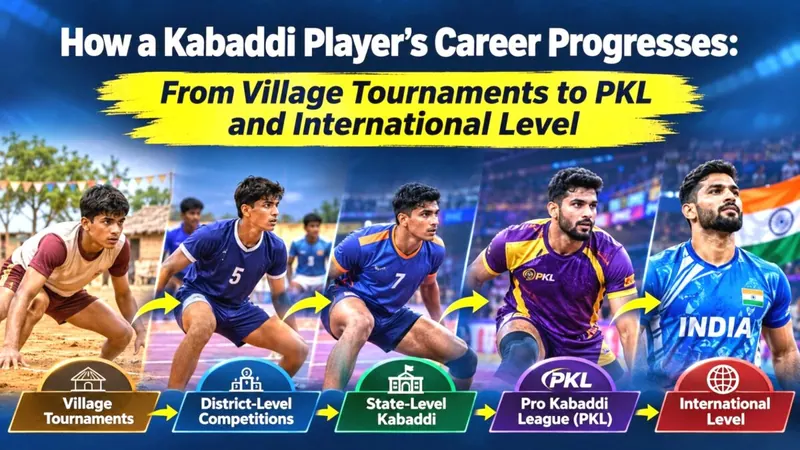
Indian kabaddi has a strong connection with villages, local sports grounds, schools, colleges and training academies. Many players start playing kabaddi with friends in their village or town before they even think about making it a career. At first, they may play in local tournaments for a small prize, a team trophy or the chance to represent their village. However, with regular practice, good coaching and strong performances, these early matches can become the starting point of a professional kabaddi career.
Today, kabaddi players in India have several career routes to follow. They can compete in district and state championships, join sports academies, represent their schools or universities, enter national competitions and work towards playing in professional leagues such as the Pro Kabaddi League (PKL). Players who perform well at higher levels can also get opportunities to join national camps and compete for a place in the Indian kabaddi team. However, every player follows a different path, and there is no single route that guarantees success.
The journey from local kabaddi to PKL requires much more than talent. Players need to improve their fitness, learn different playing techniques, compete against stronger teams and understand how organised kabaddi works. They must also manage their education, family responsibilities, expenses and recovery from injuries. This article explains the main stages of a kabaddi player’s career, the opportunities available at each level and the practical steps young Indian players can follow to build a future in the sport.
Starting the Journey: Village and Local Kabaddi Tournaments
For many Indian kabaddi players, the first step comes at the village level. Children often begin playing on open grounds, school playgrounds or local sports fields with friends and older players. In several parts of India, especially in states such as Haryana, Uttar Pradesh, Punjab, Maharashtra, Rajasthan and Tamil Nadu, kabaddi is played in villages and towns as part of local sports events. These games help young players develop basic skills, understand teamwork and build an interest in competitive sport.
Village tournaments and local competitions provide an early chance to test these skills. Some tournaments are organised by local sports clubs, village committees, schools, colleges or private organisers. Players may compete for their village, neighbourhood or local team, while some events attract teams from nearby districts or states. The level of competition varies, but these matches can help a player understand how to raid, defend, work with teammates and make quick decisions during a game.
Young players should use these tournaments to identify their strengths and weaknesses. A raider can practise toe touches, running hand touches, escapes and safe returns to the home court, while a defender can work on ankle holds, thigh holds, blocks and chain tackles. Players should also learn the basic rules of the sport and listen to experienced coaches. These early lessons become useful when they move into more organised competitions.
However, playing well in a village tournament does not automatically lead to selection at a higher level. Players need to find competitions where stronger opponents, qualified coaches and organised teams can assess their progress. They should also ask about school teams, local sports clubs, district associations and nearby academies that provide regular training. The aim at this stage is to move from playing kabaddi casually to learning and competing in a more organised way.
Joining a Kabaddi Academy or Training Centre
An important step in a young kabaddi player’s career is joining a good training academy or sports centre. Local matches can help players discover their talent, but regular coaching helps them improve their game in a planned way. A trained coach can study a player’s technique, correct mistakes, improve fitness and suggest the right playing position. Players also get the chance to practise with teammates who have similar goals.
Kabaddi academies may offer training in raiding, defence, match planning, strength, speed, balance and stamina. A player should not focus only on physical strength because kabaddi also requires timing, control, quick movement and teamwork. Raiders need to improve their footwork, understand defenders’ positions and learn when to attack or return safely. Defenders need to judge a raider’s movement, maintain the right distance and coordinate tackles with their teammates.
India also has government-supported training options for young athletes. The Sports Authority of India (SAI) runs its Sports Training Centre scheme for selected junior athletes, including kabaddi players, and its National Centres of Excellence also include kabaddi among their sports. Depending on the scheme and centre, selected athletes may receive coaching, sports equipment, competition exposure and other support. Admission and selection depend on the relevant centre’s rules, available places and trial process.
For players who cannot afford an expensive private academy, government centres, school teams, university programmes and local sports departments may offer other options. They should check official notices for age limits, trial dates, documents, training arrangements and any charges. Before joining an academy, players should also check the coach’s experience, the quality of the playing surface, the training schedule and the opportunities to compete in recognised tournaments.
Moving from Local Matches to District-Level Competitions
District-level competitions are an important step in the organised kabaddi pathway. These tournaments bring together stronger players from different local teams, schools, clubs and training centres. A player may have to compete with people who have more match experience, better fitness or more advanced techniques. This makes district competitions useful for understanding how far the player has progressed.
The exact process for district selection varies between states and competition organisers. Some events may have open entry, while others may require selection trials, registration through an affiliated body or qualification through an earlier competition. Players should check which organisation is conducting the tournament and whether the competition is recognised by the relevant district or state sports body. Not every local tournament is part of the official district-to-state competition structure.
At this stage, players should start keeping a record of their performances. They can note the tournaments they played, their team’s results, their playing position and their individual contributions. Raiders can record raid points and unsuccessful raids, while defenders can track successful tackles and mistakes. Such records help coaches understand a player’s development, although coaches will also look at movement, teamwork and decision-making rather than relying on numbers alone.
Players should also learn to perform their role within a team instead of trying to collect points in every raid or tackle. A raider may need to support another raider, while a defender may need to wait for a teammate before making a move. Good communication, correct timing and discipline become more important as the level of competition rises. Strong performances at district level can help a player seek trials or selection opportunities for higher-level competitions.
State-Level Kabaddi: A Major Career Step
State-level kabaddi offers players a chance to compete against some of the best athletes from their state. Players may enter through district competitions, state selection trials, school or university competitions, clubs, or other routes allowed by the relevant organisers. The process differs across states and tournaments, so young athletes should follow official selection notices instead of depending only on verbal information.
At this level, players face stronger opposition and often need a better understanding of team tactics. A raider must recognise different defensive formations and know how to escape from difficult situations. Defenders must learn how to work as a unit, especially when facing experienced raiders who can read gaps in the defence. Coaches may also assess fitness, discipline, consistency and the ability to follow match plans.
State championships can help players gain recognition among coaches, selectors and other teams. Strong performances may lead to opportunities in national-level tournaments, training camps or club competitions. Some players may also catch the attention of professional teams through their performances in state competitions. However, state-level success does not guarantee national selection or a PKL contract, because each opportunity has its own selection process.
A player should therefore treat every state competition as both a match and a learning experience. Studying match footage, reviewing mistakes with coaches and improving fitness after the tournament can help prepare them for the next challenge. Athletes should also maintain valid identity documents, age-related records where required, competition certificates and any registrations needed for selection. Keeping these records organised can make it easier to complete applications when new opportunities appear.
School and College Kabaddi: Another Route to Recognition
Not every kabaddi player reaches the state level through a village team or a private academy. Schools and colleges can provide another route into organised competition. School tournaments help younger athletes build match experience, while college competitions allow players to develop their game alongside their education. This route can be especially helpful for families who want a player to continue studying while pursuing kabaddi seriously.
Players may take part in school championships, university events and other competitions open to their age group or educational institution. At the college level, performance in organised tournaments can help athletes gain attention from coaches and teams. Some professional kabaddi player pools have also included athletes from university-level competitions. For example, the official PKL Season 11 auction announcement in 2024 stated that its player pool included players from the Khelo India University Games finalists.
A school or college player should communicate with the sports department to understand the available tournaments and selection requirements. Regular attendance, fitness training and match practice can help athletes improve while keeping their education on track. Players should also ask whether their institution provides access to a qualified kabaddi coach, a playing ground, sports equipment or support for travelling to competitions.
Education should not be treated as a barrier to a sports career. In fact, it gives players another skill set and additional career options. A player who later moves into coaching, sports management, physical education or another profession may benefit from having educational qualifications. Balancing study and training requires planning, but it can reduce the risk of having no alternative if a professional sports career does not develop as expected.
Khelo India and Other Talent Development Opportunities
Khelo India is one of the government programmes that supports sports development and talent identification in India. Its activities include sports competitions, talent search and development, support for training facilities and other measures intended to help athletes move from basic participation towards higher levels of sport. Kabaddi is included among the sports covered by the programme’s training and competition system.
For a young kabaddi player, a Khelo India competition or an associated training opportunity may provide another chance to compete against strong opponents. Players should follow the official announcements for the particular competition, including age categories, eligibility conditions, selection rules and registration deadlines. Different Khelo India competitions have different entry requirements, so participation in one event does not mean that a player automatically qualifies for every other event or training scheme.
Selection for athlete support can involve more than winning a single match. Depending on the programme, coaches and selectors may assess match performance, skill, fitness, age eligibility and improvement over time. Athletes who are selected may receive support according to the applicable scheme and its rules. However, the number of places is limited, and training or financial assistance should never be assumed before official confirmation.
Young athletes should also keep checking the official websites of SAI, Khelo India, their state sports department and the relevant kabaddi federation. These sources may announce selection trials, training opportunities and competition schedules. Following official notices helps players avoid relying on outdated information, unofficial claims or people who promise selection in exchange for money.
National-Level Kabaddi: Competing with India’s Best Players
National-level competitions bring together leading players from different parts of India. Reaching this stage usually requires a strong record of performance, suitable fitness and selection through the process set for the relevant championship. Opportunities may be available through junior, sub-junior, senior, school, university or other recognised competition categories, depending on the event’s rules.
The Amateur Kabaddi Federation of India (AKFI) publishes national competition notifications and other official information, including notices related to junior and senior championships, selection committees and international-team preparation. Players and coaches should use the latest relevant notices to understand the process for a specific tournament. National competitions and selection systems can change, so an older tournament’s rules should not be treated as the rules for every future event.
At the national level, the quality of the opposition can expose gaps that may not have been visible in local or state matches. A raider may need to improve against defenders who time their tackles well, while a defender may face raiders with a wide range of attacking moves. Match fitness, recovery, communication and the ability to follow a coach’s plan become increasingly important. Players also learn to handle longer competitions, travel schedules and the demands of playing several matches over a short period.
National tournaments can help athletes get noticed by coaches, selectors and professional teams, but there are no guaranteed results. The number of available places depends on the competition and the selection criteria. A player who does not get selected on the first attempt should review their performance, ask for useful feedback where possible and continue preparing for future opportunities. A clear training plan and regular competition experience can be more useful than changing academies or coaches after every setback.
How Kabaddi Players Can Reach the Pro Kabaddi League (PKL)
The Pro Kabaddi League is one of the main professional opportunities for Indian kabaddi players. It gives selected athletes the chance to play for a franchise, train in a professional team environment and compete against leading domestic and international players. However, reaching PKL is not a simple step after winning a village or district tournament. Players usually need to build their reputation through organised competitions, strong match performances, training programmes or talent scouting.
There are several possible routes into the league. A player may stand out in a state or national competition, perform well in university kabaddi, attract attention through an academy or be considered through a talent-identification programme. Professional teams look for players who can meet their requirements in particular positions, such as raiders, defenders and all-rounders. The route can differ from one player to another, depending on age, experience, performance and the opportunities available.
PKL has previously run programmes designed to identify and prepare young players for professional kabaddi. One example was the Future Kabaddi Heroes (FKH) programme, which used trials, multiple selection stages and a training camp before selected players entered the auction pool. The league reported that players including Nitesh Kumar, Surender Singh and Rohit Gulia came through this programme. These are examples of how organised scouting and training have provided routes to the professional level; they do not mean that the same programme is necessarily accepting players today.
PKL teams also consider players from the domestic kabaddi circuit. The league has reported that talent from local tournaments across India can reach the professional level, with some young players getting opportunities to play alongside experienced athletes. The presence of new players in the league shows why match performance, regular training and visibility in competitive kabaddi are useful for aspiring professionals. Still, only a limited number of players receive contracts, and a strong tournament alone does not guarantee selection.
Main routes to a PKL opportunity
| Career route | What a player should do |
| Local and district tournaments | Build skills, gain match experience and move towards organised competitions. |
| State and national championships | Compete against stronger opponents and develop a record of performance. |
| School and university kabaddi | Take part in recognised competitions and use the opportunity to gain match experience. |
| Kabaddi academies and training centres | Train under qualified coaches and seek legitimate trials or tournament opportunities. |
| Official talent-identification programmes | Apply when a relevant programme is announced and meet its eligibility conditions. |
| Professional team scouting | Perform well in competitions where team scouts or coaches can assess players. |
These routes can overlap. For example, a player may compete for a college team while training at an academy and representing a district team in another competition. A young athlete should choose a route that suits their current level, education, location and resources rather than waiting for a single opportunity to solve everything.
Understanding PKL trials, scouting and auctions
Aspiring players should understand that a trial, scouting opportunity and auction are different stages. A trial allows selectors or coaches to assess a player’s skills and fitness. Scouting means observing athletes in competitions or training settings to identify players who may suit a team. An auction is the process through which eligible players in the pool are selected by franchises according to the rules of that particular PKL season.
The exact player pool, categories, eligibility conditions and team selection rules can change between seasons. For example, PKL has used categories such as New Young Players, Existing New Young Players and Retained Young Players in its auction and squad system. The league’s official season announcements explain the arrangements for that season. Players should therefore check current PKL notices instead of relying on an old auction format.
Players should use official league and team websites to look for genuine announcements. They should be careful about anyone who promises a PKL contract or guaranteed selection in exchange for money. Paying an unofficial agent or travelling to an unverified trial can waste money and put the athlete at risk. Before sharing personal documents or making a payment, players and their families should verify the organiser and the purpose of the event.
Choosing a Playing Position and Building a Strong Profile
As players move into higher competitions, it becomes useful to understand which role best suits their skills. Kabaddi has three broad playing profiles: raiders, defenders and all-rounders. Although players may perform more than one role, developing a clear understanding of their strengths helps them train in a focused way. Coaches may also look for players who can fill a particular position in a team.
| Playing role | Important skills to develop |
| Raider | Footwork, hand touches, toe touches, timing, escape moves and safe returns. |
| Defender | Ankle holds, blocks, thigh holds, chain tackles, positioning and coordination. |
| All-rounder | Reliable raiding and defence skills, stamina, balance and adaptability. |
| Team captain or organiser | Communication, knowledge of match situations, discipline and teamwork. |
A player’s profile should contain useful information about their playing history. This can include their age, playing position, height and weight where relevant, academy or club, tournament participation and verified results. Short clips of real match performances can also help a coach understand the player’s movement and technique. Videos should show genuine play and should not be edited in a way that hides mistakes or creates a false picture of the athlete’s skills.
Keeping records up to date can help when applying for trials and contacting coaches. Players should save certificates, registration documents, selection letters and other competition records. They should not exaggerate their achievements, claim selection they have not received or use another player’s statistics. An honest and clear profile gives coaches better information when they assess a player.
From PKL Player to the Indian Kabaddi Team
Playing in PKL can improve a player’s experience and visibility, but it is not an automatic route into the Indian national team. National-team selection is a separate process and depends on the relevant selection criteria, competitions, camps and decisions of the authorised bodies. A player can have a professional contract and still need to prove that they are suitable for national selection.
The national-team journey generally involves performing well in the relevant competitive environment and meeting the requirements of the selection process for a particular event. Coaches and selectors may look at technical skills, fitness, defensive or raiding contribution, teamwork and performance against strong opposition. The exact assessment and eligibility rules depend on the competition and the governing body’s applicable notices.
Players who reach national camps may have to compete with experienced athletes and other talented players seeking the same place. They need to maintain their fitness, recover well between matches and follow the training plan given by the coaching staff. They may also need to adjust to different team combinations and tactical instructions. Good preparation and regular performance can support their chances, but no player can assume selection before the final team is announced.
For players who are not selected, the best response is to understand what needs improvement and continue working on it. Some may return to domestic tournaments or PKL, while others may focus on fitness, tactical skills or a particular weakness. A professional career is often built through repeated efforts over several years, rather than a single tournament or one selection camp.
Fitness, Diet, Recovery and Injury Prevention
Kabaddi is a physically demanding sport. Players need speed to raid, strength to tackle, stamina to stay active throughout a match and balance to move safely in different directions. They also need enough recovery to maintain their performance across training sessions and tournaments. For this reason, fitness should improve alongside kabaddi skills, rather than being treated as an extra task.
A useful training plan may include running, short sprints, strength exercises, movement drills, flexibility work and sport-specific practice. The exact plan should depend on the player’s age, experience, position and current fitness. Younger athletes should work with qualified coaches and use proper technique instead of copying heavy gym workouts designed for experienced adults.
Diet and sleep also affect training and recovery. Players should aim for balanced meals that provide enough energy, protein, carbohydrates, healthy fats, vitamins and minerals. Drinking enough water is important, particularly during training in hot weather. They should avoid unverified supplements and seek advice from a qualified health professional when they need guidance on nutrition or injury care.
Injuries should never be ignored simply because a tournament or selection trial is approaching. Players who experience pain, swelling or difficulty moving should seek suitable medical assessment and follow the recovery plan recommended to them. Returning too early can make an injury worse and affect their longer-term progress. Taking care of the body is part of building a sustainable kabaddi career.
Managing Education, Money and Family Responsibilities
A kabaddi career requires financial and personal planning, especially in its early stages. Local and district players may have to pay for travel, food, equipment, academy fees and accommodation. Some families can afford these costs, while others need help from schools, sports departments, clubs or training schemes. Players should understand their expenses before committing to a long training programme.
Athletes and their families should ask about the full cost of joining an academy or attending a tournament. This includes registration fees, travel, stay, food, kit and any other charges. They should also confirm whether the organiser provides accommodation, meals or reimbursement. Keeping a simple record of expenses can help families plan and avoid unexpected costs.
Education can provide stability during the years when a player is still working towards professional selection. School and college qualifications may also support future jobs in coaching, sports administration, physical education or other fields. Players should discuss their training schedule with family members and teachers so that important exams and competitions can be managed properly.
Athletes should also avoid making major financial decisions based on the hope of receiving a professional contract. PKL places are limited, and the timing of selection can vary. A realistic plan includes continued training, education, responsible spending and other career options. This allows players to pursue kabaddi seriously without depending entirely on an uncertain outcome.
Alternative Career Opportunities in Kabaddi
Not every talented player will represent India or sign a PKL contract, but kabaddi can still provide other career options. Depending on their skills, experience and eligibility, players may explore state-level competitions, university sports, institutional teams, local leagues and other organised tournaments. The opportunities available vary by location, employer, organisation and season.
Experienced players may also consider coaching after gaining the necessary knowledge and qualifications. Coaching can involve training children, working at an academy, helping school teams or supporting a club. Some players may move into refereeing, match organisation, sports administration, fitness training or other roles related to the game. These positions may require separate training, certification or practical experience.
Players can also gain useful knowledge of match analysis, event management, sports media and tournament organisation. Understanding the rules of kabaddi, preparing match reports, maintaining records and communicating with teams can help athletes develop skills beyond their playing role. However, they should check the requirements of each profession and build the relevant skills rather than assuming that playing experience alone qualifies them for every job.
Planning for life beyond professional competition is sensible because players may have to stop playing at a high level due to injury, age or personal reasons. Building qualifications, communication skills and work experience alongside kabaddi can give them more choices later. A sports career can include playing, coaching and working in the wider sports industry at different stages of life.
Practical Career Plan for Young Kabaddi Players
The best route depends on a player’s current age, playing level, location, access to coaching and competition record. Still, a simple plan can help young athletes decide what to focus on at each stage. The stages below are a guide, not a fixed timeline, because players develop at different speeds and competition systems vary between states.
| Stage | Main goal | Practical action |
| Beginner | Learn the basics | Play regularly, understand the rules and practise the correct techniques. |
| Local competitor | Gain match experience | Participate in village, school or local club tournaments. |
| District-level player | Improve competitive skills | Find organised district events and seek coaching feedback. |
| State-level player | Compete against stronger opponents | Follow state notices, attend eligible trials and enter recognised competitions. |
| National-level prospect | Improve consistency | Build a competition record and prepare for national selection processes. |
| PKL hopeful | Gain professional visibility | Follow genuine scouting announcements, improve match performance and maintain a playing profile. |
| Professional player | Maintain performance | Follow team training, improve weaknesses and manage fitness and recovery. |
| National-team hopeful | Meet selection requirements | Perform well and follow the official process for camps and team selection. |
Players should review this plan regularly with a coach or trusted mentor. If progress slows, they can identify whether the problem is fitness, technique, limited match practice or a lack of access to the right competitions. They can then work on that specific area instead of making several changes at once.
It is also useful to set clear short-term goals. For example, a player may aim to improve their weaker raid move, make fewer tackling mistakes or reach a particular district competition. Small, measurable goals make training more focused and help players see improvement over time. Long-term ambitions such as playing PKL or representing India can remain the target, while daily training and competition provide the steps towards it.
A kabaddi player’s career can begin on a village ground and gradually move towards district, state and national competitions, professional leagues and international representation. Each stage offers different challenges and learning opportunities. Local tournaments help players start competing, academies support skill development, school and university competitions provide additional routes, and organised national events can give talented athletes opportunities to progress.
For players who want to reach the Pro Kabaddi League, the main priorities are regular training, strong performances, genuine competition experience and awareness of official trials or scouting opportunities. Reaching the Indian kabaddi team requires a separate selection process, and neither a PKL contract nor a single tournament result guarantees national selection. Players should focus on improving their own game while keeping their education, health and finances in order.
The most useful approach is to treat kabaddi as a long-term career plan. With good coaching, discipline, match experience and realistic goals, young players can work towards higher levels of the sport while keeping other career options open. Every player’s journey is different, but a clear plan can help them understand the available routes and make better decisions at each stage.